
Gear progression: the order that wastes nothing
Push one weapon through normal enhancement, add Overgeared slot options to that same piece, then spend on modification and Overclock once the enhancement cap forces a breakthrough. Spread nothing across five items in week one.
A gear game punishes the player who spreads materials. TEMPPAL: OVERGEARED gives you four systems that all touch the same weapon, and the order you use them in decides whether your first week produces one strong item or five mediocre ones. This page turns Nexon's system descriptions into a spending order you can follow without knowing a single unpublished number.
The four systems and what they actually change
Nexon's listing separates them clearly enough to build a plan on, even though it publishes no values.
| System | Nexon's wording | Practical meaning |
|---|---|---|
| Enhancement | Implied by "standardized enhancements" | Raises the item's base power in steps |
| Weapon Modification | "changes a weapon's appearance and performance" | Reworks the weapon itself, not a slot |
| Overgeared | "slot options on individual gear pieces" | Adds or rerolls options on one item's slots |
| Overclock | "rule-breaking power" that scales with equipment level | A boost whose value grows with the gear it sits on |
Inven's broadcast report, summarised by MobileNApps, fills in two mechanics that Nexon's own text only gestures at: a breakthrough step once an enhancement cap is reached, and God Hand Memories that come in Offensive, Defensive and Auxiliary types. Both are reported rather than official, so plan around them but do not treat the numbers as fixed.
The order to spend in
- Pick one weapon and one armour set, and stop picking. Every system below multiplies whatever item you put it on, so a decision made on day one is worth more than a perfect decision made on day ten.
- Enhance the weapon in normal steps until the game stops you. This is the cheapest power you will buy all week, and it does not require a decision about which option to keep.
- At the cap, take the breakthrough step if it is offered. Reported by Inven, not confirmed by Nexon. If the step asks for a rare material, check the shop price before you commit; this is the first place where a paid shortcut can look tempting.
- Add Overgeared slot options to the same weapon. Options are the part that makes an item yours, and they are also the part that a later replacement throws away, which is exactly why you do it after the item has proven itself.
- Modify the weapon only once you know the class line you are staying on. Modification changes appearance and performance together, so it is the wrong spend while you are still testing classes.
- Turn on and invest in Overclock last. It scales with equipment level, so every enhancement you do first makes it worth more.
A week-one budget table
| Day | Do this | Bank this | Do not do this |
|---|---|---|---|
| 1 | Main quest to open systems, one enhancement | Catalysts, enhancement material | Buy anything from the shop |
| 2 | Push the weapon to its first cap | Breakthrough material | Modify a second weapon |
| 3 | First Overgeared options on the weapon | Alchemy catalysts | Spread options across armour |
| 4 | Armour enhancement, same set | Pavranium if it drops | Reroll a good option |
| 5 | Breakthrough decision | Everything paid | Chase a cosmetic |
| 6 | Modification if the class is settled | Materials for one more step | Start a second character |
| 7 | Review: what did each step return | Record income per run | Spend to "catch up" |
The right-hand column is the part that matters. Most week-one losses come from doing three of those things at once on day two.
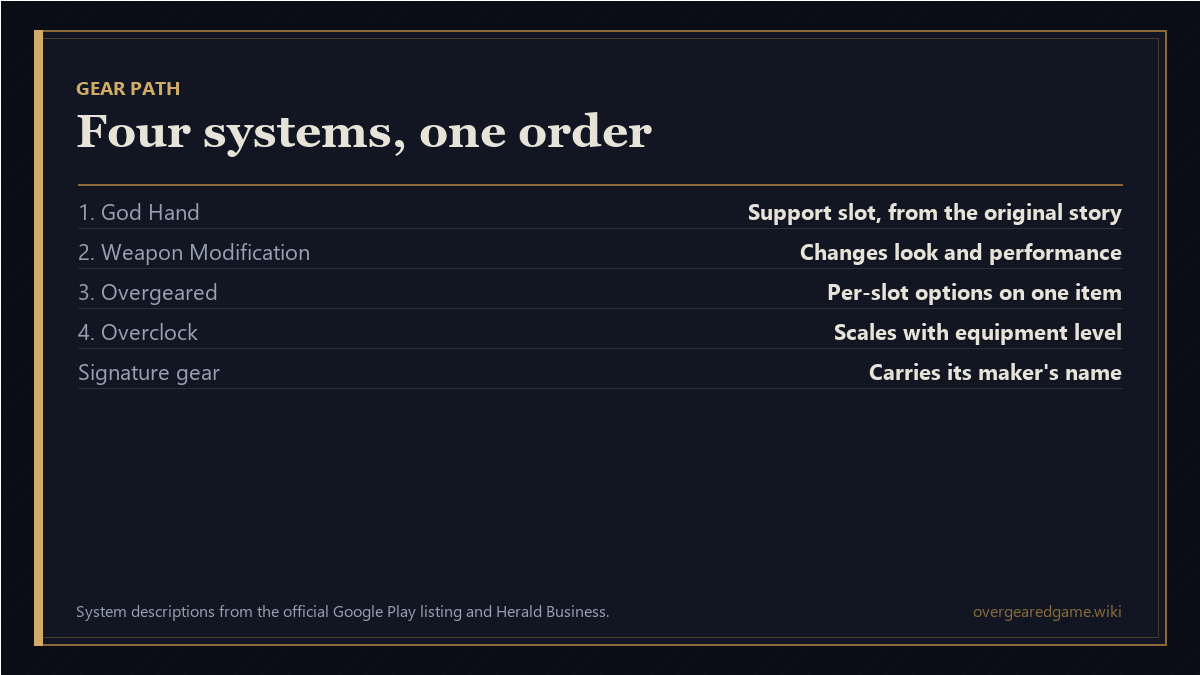
System order derived from Nexon's listing and the Herald Business summary. No costs are published.
Where God Hand fits
God Hand is the support slot the game inherits from the original story, and Nexon pairs it with Overclock in the same sentence: "the reliable support of the God Hand with the rule-breaking power of Overclock". Inven's report describes equippable God Hand Memories in three types. If that holds, treat it as a loadout decision rather than a material sink:
| Type | Choose it when | Cost of getting it wrong |
|---|---|---|
| Offensive | You are the party's damage anchor | Low: swap when content changes |
| Defensive | You are tanking waves or bosses | Low, but slows solo clear speed |
| Auxiliary | You are supporting a fixed group | Highest, because it only pays in a group |
Because the type is a choice rather than a roll, it is the one decision you can make before launch without spending anything.
Three mistakes that cost a week
Enhancing everything evenly. The first cap is cheap; the second is not. Five items at the first cap are weaker than one item past it, and the game's challenge modes are built around a single strong weapon doing the work.
Modifying before choosing a class. Modification changes performance, and performance is class-specific. Nexon has confirmed four weapon classes; Inven's report names four weapon lines. Changing line after a modification is the most expensive possible sequence.
Buying catalysts on day one. Confirmed alchemy catalysts are one of the two things the shop is expected to sell, alongside Pavranium. Prices in the first 48 hours are set before anyone knows the drop rate, so the same purchase on day eight is usually cheaper and always better informed.
Unknowns that matter
Level caps, enhancement success rates, breakthrough costs, option pools, Pavranium drop rates and cash shop prices are all unpublished. This page gives the order, not the numbers, and it will be updated with measured values once the servers are live and the first players have run the loop.
Related: the Overgeared and Overclock explainer for the two systems that carry the endgame, and the first 90 minutes for what to open before any of this matters.